UP PCS: Complete Guide to Exam, Syllabus, Eligibility, and Preparation
Uttar Pradesh is home to over 240 million people. It has more districts than most countries have states. And yet, thousands of critical administrative posts sit vacant every year. The UP PCS examination is the primary mechanism that fills those posts, placing officers across revenue, police, development, and judicial departments.
If you are serious about a career in Uttar Pradesh’s state services, this guide covers everything you need to know, from eligibility to exam pattern, syllabus to salary, and strategy to common mistakes.
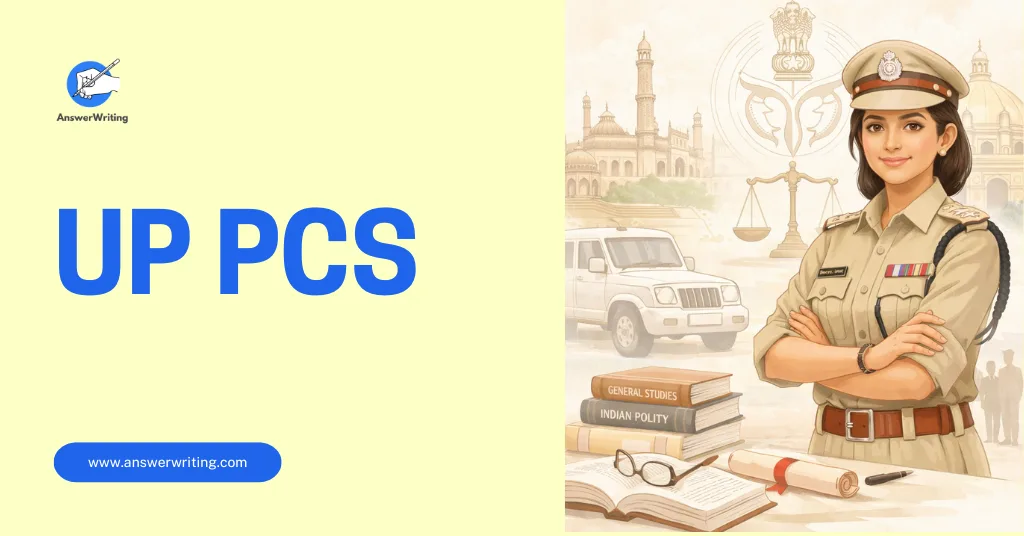
What is UP PCS?
UP PCS stands for Uttar Pradesh Provincial Civil Service. It is conducted by the Uttar Pradesh Public Service Commission (UPPSC), headquartered in Prayagraj.
UPPSC derives its authority from Article 315 of the Indian Constitution, which mandates the establishment of a Public Service Commission for every state. The commission is responsible for recruiting officers to Group A and Group B posts in the state government.
The full name of the flagship exam is the Combined State/Upper Subordinate Services Examination, commonly called UP PCS. It is held annually (though delays have occurred historically).
Posts Filled Through UP PCS
UP PCS fills a wide range of posts across departments. The most coveted is Deputy Collector (SDM), but the exam recruits for over 20 different services.
| Post | Department | Pay Level (7th CPC) |
|---|---|---|
| Deputy Collector (SDM) | Revenue | Level 12 (Rs. 56,100+) |
| Deputy Superintendent of Police (DSP) | Police | Level 11 (Rs. 67,700+) |
| Block Development Officer (BDO) | Panchayati Raj | Level 11 |
| District Commandant (Home Guard) | Home | Level 11 |
| Assistant Commissioner (Commercial Tax) | Taxation | Level 10 |
| District Minority Welfare Officer | Minority Welfare | Level 10 |
| District Food Marketing Officer | Food & Civil Supplies | Level 10 |
| Treasury Officer | Finance | Level 10 |
| Assistant Labour Commissioner | Labour | Level 10 |
| Cane Inspector | Sugar Industry | Level 9 |
The number of vacancies varies each cycle. Recent cycles have advertised anywhere between 200 and 600+ posts depending on government requirements.
UP PCS Eligibility Criteria
Educational Qualification
Candidates must hold a graduation degree from any recognized university. The subject of graduation does not matter for most posts, except for a few technical or departmental roles.
Final-year students can also apply, provided they submit proof of degree by the time of document verification.
Age Limit
| Category | Minimum Age | Maximum Age |
|---|---|---|
| General (Unreserved) | 21 years | 40 years |
| OBC (UP Domicile) | 21 years | 43 years |
| SC/ST (UP Domicile) | 21 years | 45 years |
| Ex-Servicemen | 21 years | As per rules |
| PwD (General) | 21 years | 55 years |
| PwD (OBC) | 21 years | 58 years |
| PwD (SC/ST) | 21 years | 60 years |
Age is calculated as of July 1 of the examination year. State domicile is mandatory for reserved category age relaxations.
Number of Attempts
UPPSC does not prescribe a fixed limit on the number of attempts. As long as a candidate is within the age limit, they can keep appearing. This is a significant difference from UPSC, which caps attempts for each category.
UP PCS Exam Pattern at a Glance
The selection process has three stages.
Stage 1: Preliminary Examination
The Prelims is a screening test. Marks scored here are not counted in the final merit list.
| Paper | Subject | Questions | Marks | Duration |
|---|---|---|---|---|
| Paper 1 | General Studies | 150 | 200 | 2 hours |
| Paper 2 | CSAT | 100 | 200 | 2 hours |
Both papers are objective (MCQ) type. Paper 2 (CSAT) is qualifying in nature with a minimum passing mark of 33%. Negative marking applies: one-third of marks are deducted for each wrong answer.
Stage 2: Mains Examination
Mains is a written descriptive exam. It is the most critical stage and determines your final rank.
| Paper | Subject | Marks | Duration |
|---|---|---|---|
| Paper 1 | General Hindi | 150 | 3 hours |
| Paper 2 | Essay | 150 | 3 hours |
| Paper 3 | General Studies I | 200 | 2 hours |
| Paper 4 | General Studies II | 200 | 2 hours |
| Paper 5 | General Studies III | 200 | 2 hours |
| Paper 6 | General Studies IV | 200 | 2 hours |
| Paper 7 | Optional Subject (Paper 1) | 200 | 2 hours |
| Paper 8 | Optional Subject (Paper 2) | 200 | 2 hours |
| Total | 1500 |
General Hindi is qualifying (minimum 35% required). The remaining 1350 marks (Essay + GS I to IV + Optional) count toward merit.
Stage 3: Interview/Personality Test
Candidates who clear Mains are called for an interview worth 100 marks. The final merit list is prepared out of 1500 marks (Mains 1400 + Interview 100).
Wait, to clarify: General Hindi (150 marks) is qualifying only, so effective merit marks = Essay (150) + GS I-IV (800) + Optional (400) + Interview (100) = 1450 marks.
UP PCS Prelims Syllabus (Detailed)
Paper 1: General Studies
- History of India and Indian National Movement
- Indian and World Geography (Physical, Social, Economic)
- Indian Polity and Governance (Constitution, Political System, Panchayati Raj, Public Policy, Rights)
- Economic and Social Development (Sustainable Development, Poverty, Demographics, Social Sector Initiatives)
- Environmental Ecology, Biodiversity, and Climate Change
- General Science (with focus on everyday applications)
- Current Events of National and International Importance
- Special focus: History, Culture, and Geography of Uttar Pradesh
- Agriculture, industry, and infrastructure of UP
- Population and urbanization of UP
Paper 2: CSAT (Qualifying)
- Comprehension passages
- Interpersonal skills and communication
- Logical reasoning and analytical ability
- Decision making and problem solving
- General mental ability
- Elementary mathematics (Class 10 level): Arithmetic, Algebra, Statistics
UP PCS Mains Syllabus (Detailed)
General Studies Paper I: History, Culture, and Geography
- Indian History: Ancient, Medieval, Modern
- Art and culture of India
- Indian and World Geography
- Disasters and disaster management
- UP-specific: History, culture, art, architecture, festivals, folk music
General Studies Paper II: Indian Polity, Governance, and Social Issues
- Indian Constitution: features, amendments, landmark cases
- Parliament, state legislature, executive, judiciary
- Governance, transparency, e-governance
- Panchayati Raj and urban local bodies
- Social issues: education, health, poverty, gender
- International relations and organizations
General Studies Paper III: Economy, Science, and Technology
- Indian economy: planning, growth, agriculture, industry
- Economic reforms post-1991
- Current economic issues: inflation, fiscal deficit, GST
- Science and technology: space, defense, biotechnology, IT
- Environment and sustainable development
- Agriculture in UP: crops, irrigation, land reforms
General Studies Paper IV: Ethics, Integrity, and Aptitude
- Ethics and human interface
- Attitudes, moral influence, and persuasion
- Emotional intelligence
- Public service values and ethics in public administration
- Probity in governance: information sharing, conflict of interest
- Case studies on ethical dilemmas (practical scenarios)
Essay Paper
Two essays are required, typically from different themes (social, political, economic, philosophical). Clarity of thought, structure, and balanced arguments matter more than length.
General Hindi (Qualifying)
- Apathit Gadyansh (Unseen passage comprehension)
- Sandhi and Samas
- Vilom and Paryayvachi Shabd
- Vakya Sudhi (sentence correction)
- Letter writing (official/unofficial)
- Precis writing
Optional Subject
Candidates choose one optional subject. Two papers of 200 marks each. Popular choices include:
- History
- Geography
- Sociology
- Public Administration
- Political Science and International Relations
- Economics
- Hindi Literature
- Agriculture
The optional subject can make or break your rank. Choose based on your background, interest, and scoring potential, not popularity.
UP PCS Selection Process: Step by Step
- Notification Released by UPPSC (usually on the official website uppsc.up.nic.in)
- Online Application submitted with fee payment
- Admit Card downloaded before the exam
- Preliminary Exam conducted (objective, screening only)
- Prelims Result declared, cut-offs announced category-wise
- Mains Application (DAF: Detailed Application Form) submitted by qualifying candidates
- Mains Examination conducted over multiple days
- Mains Result declared with marks
- Interview Call Letters issued to shortlisted candidates
- Personality Test (Interview) conducted at UPPSC, Prayagraj
- Final Merit List published based on Mains + Interview marks
- Document Verification and Medical Examination
- Appointment Order issued by the state government
The entire cycle typically takes 18 to 30 months from notification to appointment. Delays have been common historically, though UPPSC has been working to streamline timelines.
UP PCS Salary, Perks, and Career Growth
Pay Scale (7th Pay Commission)
| Post | Pay Level | Basic Pay (Starting) | Approximate In-Hand |
|---|---|---|---|
| Deputy Collector (SDM) | Level 12 | Rs. 56,100 | Rs. 75,000 to 90,000+ |
| DSP | Level 11 | Rs. 67,700 | Rs. 80,000 to 95,000+ |
| BDO | Level 11 | Rs. 67,700 | Rs. 78,000 to 88,000+ |
| Other Group B Posts | Level 9-10 | Rs. 53,100+ | Rs. 60,000 to 75,000+ |
In-hand salary varies based on HRA (House Rent Allowance), DA (Dearness Allowance), and city of posting.
Additional Perks
- Government accommodation (bungalow or quarters in most cases)
- Official vehicle for field postings
- Medical facilities for self and family
- Pension under New Pension Scheme (NPS) for recruits after 2004
- Job security and defined working conditions
Career Growth
A Deputy Collector typically follows this trajectory:
SDM (Deputy Collector) → Additional District Magistrate (ADM) → District Magistrate (DM) → Divisional Commissioner → Principal Secretary (State Government)
Top-performing PCS officers can also be empanelled for IAS cadre through promotion, giving them exposure at the national level.
UP PCS vs UPSC: Key Differences
| Parameter | UP PCS | UPSC (IAS/IPS/IFS) |
|---|---|---|
| Conducting Body | UPPSC | Union Public Service Commission |
| Jurisdiction | Uttar Pradesh only | All-India cadre |
| Posts | State services (SDM, DSP, BDO etc.) | IAS, IPS, IFS, IRS etc. |
| Exam Stages | Prelims, Mains, Interview | Prelims, Mains, Interview |
| Optional Subjects | 1 optional (2 papers) | 1 optional (2 papers) |
| GS Syllabus Overlap | Very high (70%+ overlap) | Same GS framework |
| Number of Attempts | No fixed limit (age-based) | 6 (General), 9 (OBC), unlimited (SC/ST) |
| Interview Marks | 100 marks | 275 marks |
| Difficulty Level | High (state level) | Very High (national level) |
| Time to Appointment | 18 to 30 months | 12 to 18 months typically |
| UP-Specific Content | Yes (mandatory in syllabus) | No |
The syllabus overlap is the biggest advantage. Many aspirants prepare for both simultaneously, with extra focus on UP-specific topics for the PCS.
How to Prepare for UP PCS: A Strategic Roadmap
Building Your Foundation
Start with NCERT books for Classes 6 to 12 across History, Geography, Polity, and Economics. These build your conceptual clarity before you move to standard references.
After NCERTs, pick up:
- Polity: M. Laxmikanth (Indian Polity)
- History: Spectrum (Modern India), Tamil Nadu Class 11-12 (Ancient/Medieval)
- Geography: NCERT + G.C. Leong (Physical Geography)
- Economy: Ramesh Singh or Nitin Singhania’s Economy notes
- UP-Specific: UP Special GK books by local publishers (Lucent UP, Dr. Arun Kumar Singh)
Handling the Optional Subject
Your optional subject is worth 400 marks in Mains. Do not pick it casually.
If you have a strong graduation background in a subject like History, Geography, or Sociology, leverage it. If not, Public Administration and Sociology are considered relatively accessible for beginners.
Solve previous years’ optional papers to understand the depth and style expected.
Mastering Answer Writing
Most students prepare content well but underperform in Mains because they never practice writing structured answers under time pressure. This is the single biggest gap.
Writing answers is a skill you build through repetition. Platforms like AnswerWriting.com allow aspirants to submit handwritten answers online and get them evaluated by experienced mentors. This kind of feedback, seeing where your arguments are weak or where your structure breaks, is exactly what separates rank holders from repeaters. Teachers and coaching institutes also use such platforms to assign and assess answer writing practice at scale.
Aim to write at least one answer daily once your Prelims preparation is solid.
Current Affairs for UP PCS
Current affairs for UP PCS must cover two layers:
- National and International: Monthly magazines like Vision IAS Current Affairs, Insights on India, or The Hindu summaries work well.
- Uttar Pradesh Specific: Follow UP government press releases, Dainik Jagran or Amar Ujala (Hindi dailies), and UPPSC’s own notifications.
UP current affairs is often neglected but carries significant weight in both Prelims GS and Mains.
Mock Tests and Revision
Start full-length Prelims mock tests at least 3 months before the exam. Analyze every wrong answer, not just your score.
For Mains, do sectional tests (paper-wise) first, then full mocks in the last two months. Revision cycles matter more than reading new material in the final phase.
Common Mistakes UP PCS Aspirants Make
- Ignoring UP-specific content: Many candidates prepare from UPSC materials alone and skip UP history, geography, and economy. This is a costly mistake.
- Skipping CSAT entirely: Treating CSAT as “just qualifying” and then failing to clear the 33% threshold. Spend at least 4 to 6 weeks on it.
- Choosing the wrong optional: Picking an optional based on what toppers chose, rather than personal strength. An optional you enjoy studying gives better results.
- Not writing answers: Reading extensively but never practising descriptive writing. Mains is a written exam. You must write regularly.
- Neglecting General Hindi: Treating it as an afterthought. Hindi paper requires genuine preparation, particularly grammar (Sandhi, Samas) and official letter formats.
- Waiting for the “perfect” resource: Switching books endlessly and never completing any single source thoroughly. One good book read five times beats five good books read once.
- Underestimating the interview: Getting to the personality test stage and then preparing casually. The interview tests your awareness of UP’s social, economic, and administrative landscape in depth.
Important Books and Resources
| Subject | Recommended Resource |
|---|---|
| Indian Polity | M. Laxmikanth |
| Modern History | Spectrum (Rajiv Ahir) |
| Ancient and Medieval History | Tamil Nadu Board Class 11-12 |
| Indian Geography | NCERT + G.C. Leong |
| Indian Economy | Ramesh Singh / Nitin Singhania notes |
| Environment | Shankar IAS Environment |
| Science and Technology | NCERT + Vision IAS material |
| Ethics (GS IV) | Lexicon for Ethics (Chronicle), G. Subba Rao |
| UP Specific GK | Lucent UP / Dr. Arun Kumar Singh |
| Current Affairs | Vision IAS Monthly, The Hindu |
| Essay Practice | Previous year papers + self-practice |
| Answer Writing | AnswerWriting.com / Coaching test series |
FAQs
Q1. Can I appear in UP PCS if I am also preparing for UPSC?
Yes, and many aspirants do exactly this. The GS syllabus overlap is over 70%. You only need to add UP-specific content and prepare a suitable optional. The strategies are complementary, not conflicting.
Q2. Is there a domicile requirement for UP PCS?
UP domicile is mandatory for reserved category (OBC, SC, ST) relaxations in age and fees. For general category candidates, domicile is not compulsory, but in practice, most recruitment notifications require it for specific posts. Always check the latest official notification.
Q3. How many times can I attempt UP PCS?
UPPSC has no fixed attempt limit. You can appear as many times as you wish, provided you are within the prescribed age limit for your category.
Q4. What is the role of optional subject in UP PCS Mains?
The optional subject carries 400 marks (two papers of 200 each) out of the total 1450 effective marks. It is a major scoring opportunity. A strong optional can significantly boost your rank.
Q5. How is the final merit list prepared?
The final merit list is based on Mains examination marks (Essay + GS I to IV + Optional = 1350 marks) plus Interview marks (100 marks), totalling 1450 marks. General Hindi is qualifying only and not counted in merit.
Q6. How long does the entire UP PCS process take from notification to joining?
Historically, the process has taken between 18 months and 3 years, depending on vacancies, legal challenges, and administrative delays. Recent cycles have been faster, but aspirants should plan for a long timeline and not lose momentum.